“How bad is the air today?” is a question Slovaks ask every winter — and every winter the answers live on a government page that updates hourly but shows you one snapshot at a time, sorted alphabetically. We wired the official feed into a live board that sorts the worst stations to the top.
Air Quality Slovakia — live board →
What the network says right now
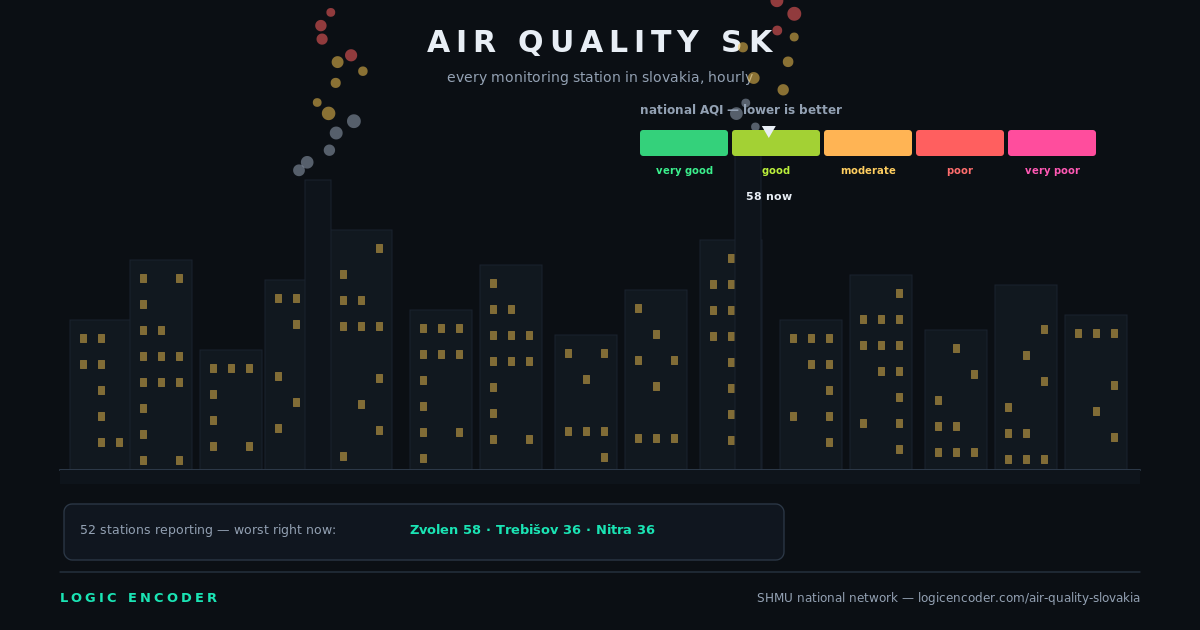
At the time of writing, 52 stations are reporting hourly readings. Today’s air happens to be good almost everywhere — 41 stations sit in the “very good” band and 11 in “good” — but the board still earns its keep:
- Zvolen, J. Alexyho is the outlier at AQI 58 — driven entirely by PM2.5 at 58 µg/m³, nearly 5× the national median of 12.
- Trebišov, Nitra-Janíkovce, Pezinok and Stará Lesná round out the top five, all still comfortably “good”.
- 21 stations read AQI ≥ 30 — the spread between the cleanest and dirtiest air in the country right now is roughly 4×.
Each row shows the national AQI plus the raw pollutant values behind it — PM2.5, PM10, NO₂, O₃ and SO₂ in µg/m³ — so you can see which pollutant is driving a bad reading. In Slovakia that’s usually particulate matter in winter inversions; in summer it’s ozone.
How the board works
The data comes straight from SHMÚ — the Slovak Hydrometeorological Institute — which runs the national monitoring network and publishes hourly readings. Our collector pulls the latest value from every station once an hour, keeps a local history, and the board re-renders itself when a new hour lands. Sortable by any pollutant, filterable to “moderate and worse” when you only care about problem spots.
Because we’re storing every hourly reading, this board quietly becomes a dataset: by January we’ll be able to answer “which Slovak town had the worst PM10 episode this winter” or “how many hours above the WHO guideline did Košice log” with our own numbers instead of anecdotes.
Why this one is local
Pan-European feeds exist, but the national network is the authoritative source for Slovak air — it’s the same data behind official smog warnings. Going straight to the source also means no API key, no rate-limit worries, and readings identical to what SHMÚ publishes itself. The honest limitation: the board shows Slovakia only, and SHMÚ marks values as unvalidated (they’re corrected later in the verified record).