- Kepler-1649 b (Kepler-1649) — habitability score 97, Teq 307 K, radius 1.02 R⊕, 300.7 ly
- TOI-2095 c (TOI-2095) — habitability score 92.1, Teq 297 K, radius 1.33 R⊕, 136.7 ly
- LP 890-9 c (LP 890-9) — habitability score 89.3, Teq 272 K, radius 1.37 R⊕, 105.8 ly
- Kepler-1126 c (Kepler-1126) — habitability score 86.1, Teq 305 K, radius 1.45 R⊕, 2073.5 ly
- K2-3 d (K2-3) — habitability score 85.7, Teq 305 K, radius 1.46 R⊕, 143.7 ly
- Kepler-62 e (Kepler-62) — habitability score 80.2, Teq 270 K, radius 1.61 R⊕, 981.3 ly
- Kepler-1652 b (Kepler-1652) — habitability score 79.9, Teq 268 K, radius 1.6 R⊕, ? ly
- Kepler-1649 c (Kepler-1649) — habitability score 79.7, Teq 234 K, radius 1.06 R⊕, 300.7 ly
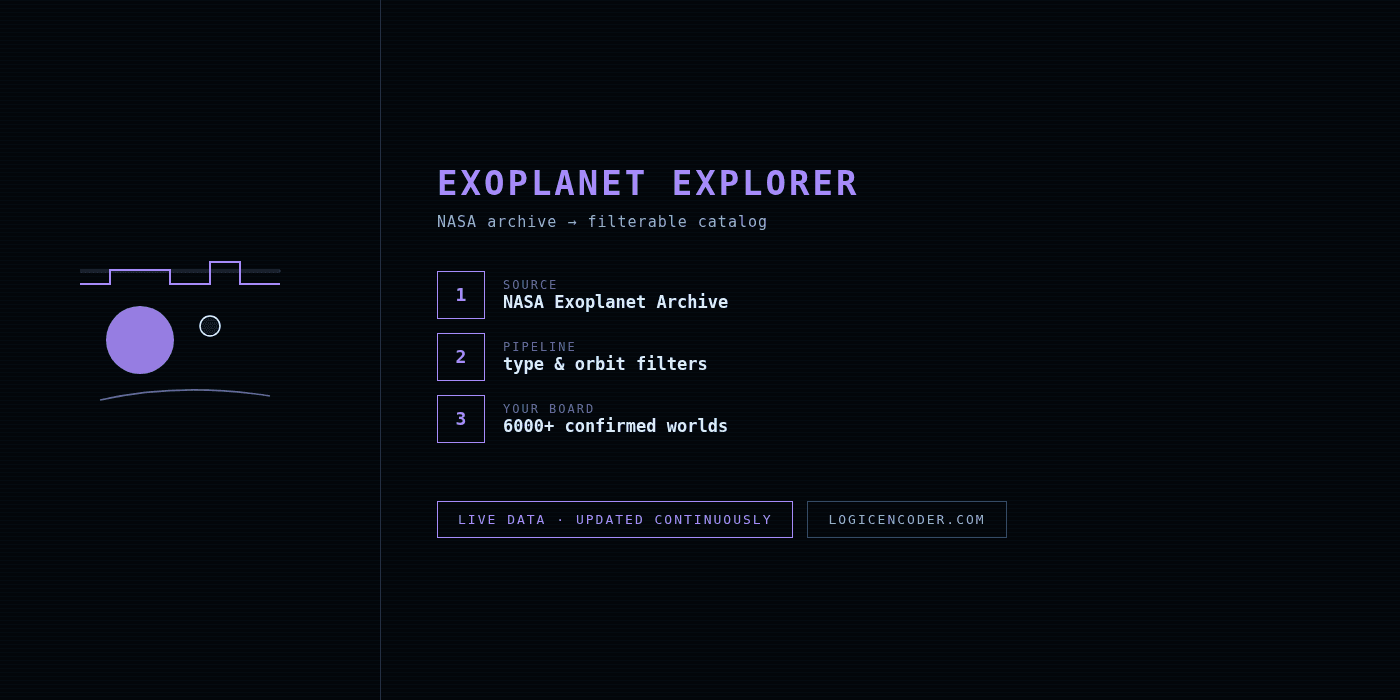
In 1995 we knew of zero planets outside our solar system. Today the confirmed count is in the thousands — hot Jupiters hugging their stars, super-Earths, mini-Neptunes, a handful of rocky worlds in habitable zones. The data is public but the catalog is a spreadsheet. This explorer turns it into something you can actually browse.
What can you filter exoplanets by?
The useful axes: planet size and type, orbital period, distance from Earth, discovery method (transit, radial velocity, imaging, microlensing), and the host star’s properties. Narrowing to “Earth-sized, habitable zone, under 100 light-years” takes seconds instead of a spreadsheet query.
Why do the size categories matter?
Because the catalog is lopsided in a way that is itself interesting. The two most common planet types in our galaxy — super-Earths and mini-Neptunes — do not exist in our own solar system at all. Meanwhile the easy finds (big, hot, close-in gas giants) dominated early discoveries purely because transit and radial-velocity methods detect them best. Browsing by type makes the observational bias visible instead of just claimed.
What is the discovery timeline worth watching?
The Kepler mission produced the population-level dataset; TESS is still finding nearby transiting worlds; and direct imaging plus JWST atmospheric characterization keep adding the weird edge cases. The explorer’s archive updates as the official catalog does.
Who is this for?
Anyone who has ever wondered “how many planets do we actually know about” — students, amateur astronomers, sci-fi writers who want a real world in a real system, or the simply curious.
Open Exoplanet Explorer
→ logicencoder.com/exoplanet-explorer/
All Logic Encoder tools at the applications page.