
Ethereum Chain Swap Monitor: read a DEX swap in its pool and transaction context
The Ethereum Chain Swap Monitor displays available Ethereum DEX swap observations, pool information, and summary panels. Its scope is Ethereum. It should not be described as a complete cross-chain flow tracker merely because several protocols appear in the same interface.
In this guide
- Ethereum Chain Swap Monitor: read a DEX swap in its pool and transaction context
- A swap event is not the whole transaction
- USD value is a valuation, not a dollar payment receipt
- Price impact and slippage are different
- Transaction fees and pool fees should not be combined carelessly
- Freshness, confirmations, and complete coverage
- A practical investigation workflow
- Questions readers often ask
The monitor covers recognised pool activity from protocols including Uniswap V2/V3, Curve, DODO, and Maverick, subject to the monitored data and source status. This is selected coverage, not every Ethereum token, pool, trade route, or blockchain. Start with the transaction, pool, pair, event time, and valuation before interpreting a large number.

A swap event is not the whole transaction
One Ethereum transaction can interact with several pools. An aggregator can route a swap through multiple steps, producing multiple pool events. A pool-level observation therefore does not automatically equal a unique person, a unique trade intention, or a single total transaction amount.
Use the transaction hash to inspect the full transaction in a block explorer. Compare the pool address, token contracts, transfers, and event sequence. A symbol is a convenient label, not a unique token identifier. The same ticker can be used by unrelated contracts, and a familiar-looking name does not establish an asset’s authenticity.
The displayed buy/sell direction is relative to the identified pair or token context. Every exchange has both sides. A “buy” label does not mean money appeared from nowhere, and an address can perform several actions within one transaction.
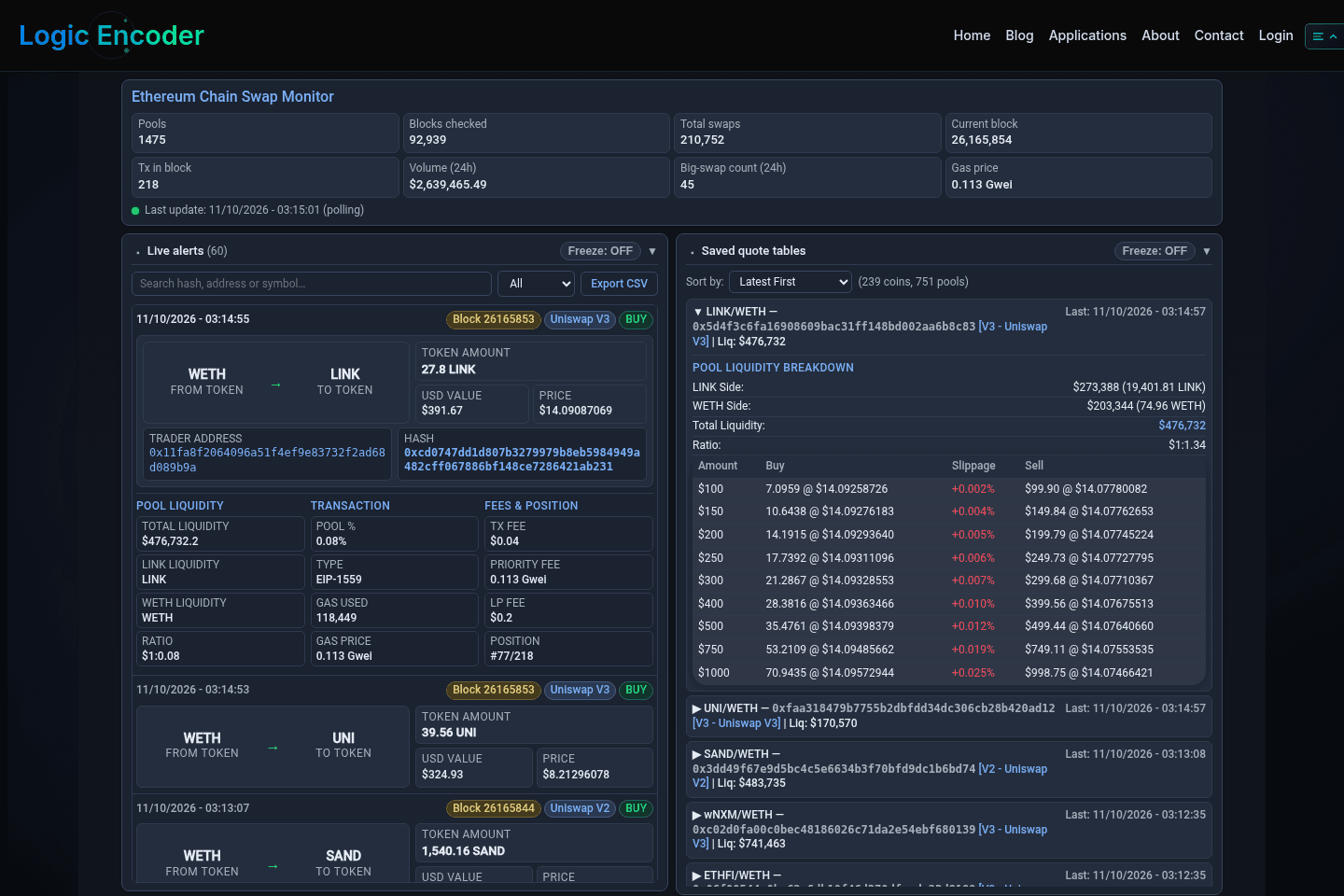
USD value is a valuation, not a dollar payment receipt
On-chain amounts are token quantities. Their USD value depends on the price reference and its timing. A USD figure can help compare events, but it is derived rather than an independent transfer of dollars. Illiquid or poorly priced tokens can make that estimate less reliable.
| Field | How to read it |
|---|---|
| Token amount | Quantity of the identified contract, with its decimal interpretation |
| Pair or quote | The asset relationship used for the displayed direction and price |
| USD value | A derived valuation using the available pricing context |
| Pool liquidity | Liquidity information for that pool and snapshot, not all liquidity everywhere |
| Trade percent of pool | A size comparison under the supplied pool-value convention |
| Transaction fee | Execution-cost context, distinct from pool trading fees |
An unavailable valuation is not zero economic value. Likewise, a pool’s displayed total value is not automatically the amount executable near the current price. Concentrated-liquidity pools distribute liquidity across price ranges, so two pools with similar total values can behave differently for an order of the same size.
Price impact and slippage are different
Price impact is the change associated with trading against a pool’s liquidity. Slippage compares expected and actual execution under changing conditions. A large swap relative to a pool can be important context, but the ratio alone does not calculate the exact execution impact.
As an explicitly hypothetical size comparison, a 50,000 USD valuation against 1,000,000 USD of displayed pool value is 5%. That arithmetic is not a prediction of 5% price impact. Pool structure, active liquidity, direction, route, fees, and market changes affect execution. Use the actual quote and transaction evidence for the specific claim.
Transaction fees and pool fees should not be combined carelessly
Ethereum execution fees concern the transaction’s gas use and effective gas price. Pool fees concern the swap’s protocol or pool terms. They are different quantities. A multi-event transaction can have one transaction fee shared across several actions, so adding a repeated fee field from every event can overstate total cost.
Use ETH Gas Tracker for fee-market context. Use the transaction receipt and protocol-specific information when determining what a completed transaction actually paid. A fee estimate shown before execution is not a receipt.
Freshness, confirmations, and complete coverage
The event time, chain state, source retrieval time, and page load time are separate. A recent-looking feed can contain older events, and source downtime can reduce available coverage. Do not interpret a temporarily empty feed as proof that no DEX trading occurred.
Recent inclusion is not the same as Ethereum finality. Chain reorganisations can change recently observed records. If finality matters, inspect the transaction and the relevant block state in an appropriate source. The monitor’s presence of an event is not itself a finality certificate.
Summary windows and filters also matter. Biggest swaps, Top tokens, volume, and buy/sell panels describe their available records and selected windows. The saved quote tables describe pool snapshots, not a guaranteed currently executable quote for your intended amount. Check the table’s update time and the specific pool before using it.
A practical investigation workflow
- Check source age and the selected time window or filter.
- Select an event and establish token contracts, pair, pool, and transaction hash.
- Inspect the full transaction so multiple pool events are not mistaken for unrelated people or independent totals.
- Read USD valuation and pool-size measures as derived context with their timestamps.
- Separate transaction execution fees from pool trading fees.
- Confirm chain status and use the relevant protocol source before making an execution or finality claim.
Questions readers often ask
Is this a cross-chain monitor?
The dashboard described here covers Ethereum observations. Several DEX protocols on Ethereum do not make it a multi-chain service.
Does one swap card equal one person buying?
No. A transaction can route through multiple pools, and an address is not a verified human identity.
Does a swap equal to 5% of pool value move price by 5%?
No. The size ratio is a comparison; actual impact depends on the pool and execution context.
Does the feed prove a transaction is final?
No. Verify its chain state and finality separately when that distinction matters.
Primary references: Uniswap’s swap explanation, Uniswap’s distinction between price impact and slippage, and Ethereum’s gas documentation.