
Quick answer: 0xDNX is an ERC-20 token on Ethereum representing DNX locked in the Dynex Holder Incentive Program (DHIP). This richlist shows every holder’s rank, exact balance, and percentage of total supply in real time — the percentage-of-supply column is what Etherscan does not calculate for you. The four key metrics at the top (total holders, total 0xDNX in DHIP, top 10 concentration %, top 50 concentration %) tell you whether the program is genuinely distributed or functionally controlled by a small group. Free, no login required.
0xDNX is wrapped DNX locked in the Dynex Holder Incentive Program (DHIP) — an ERC-20 token on Ethereum representing DNX committed to the program. The standard Ethereum block explorers show you raw token balances but give you no distribution context: what percentage of total 0xDNX supply does the top holder control? How concentrated is ownership among the top 10 versus top 50 addresses? How many unique addresses currently participate? This richlist answers those questions in real time. Free, no login required. Open the 0xDNX DHIP v2 Richlist.
Technical overview of the monitor is on GitHub: dynex-0xdnx-dhip-richlist-monitor. For on-chain DNX large transaction monitoring see the Dynex Large Transaction Monitor. For MEXC exchange-side data see the MEXC Real-Time Order Flow Dashboard. Official Dynex website: dynexcoin.org.
What is 0xDNX and how does the Dynex Holder Incentive Program work?
DHIP is the Dynex Holder Incentive Program — participants lock native DNX and receive 0xDNX, a wrapped ERC-20 token on Ethereum representing their locked position. The 0xDNX token is what this richlist tracks. It is not the same as native DNX on the Dynex chain; it is the Ethereum-side representation of DNX committed to the program.
Why does the distribution of 0xDNX matter? Because the DHIP concentrates a significant portion of DNX supply in a relatively small number of committed holders. Understanding how that supply is distributed — whether it is held by hundreds of small participants or concentrated among a handful of large addresses — gives you insight into the program’s health and potential market dynamics if holders exit or accumulate further.
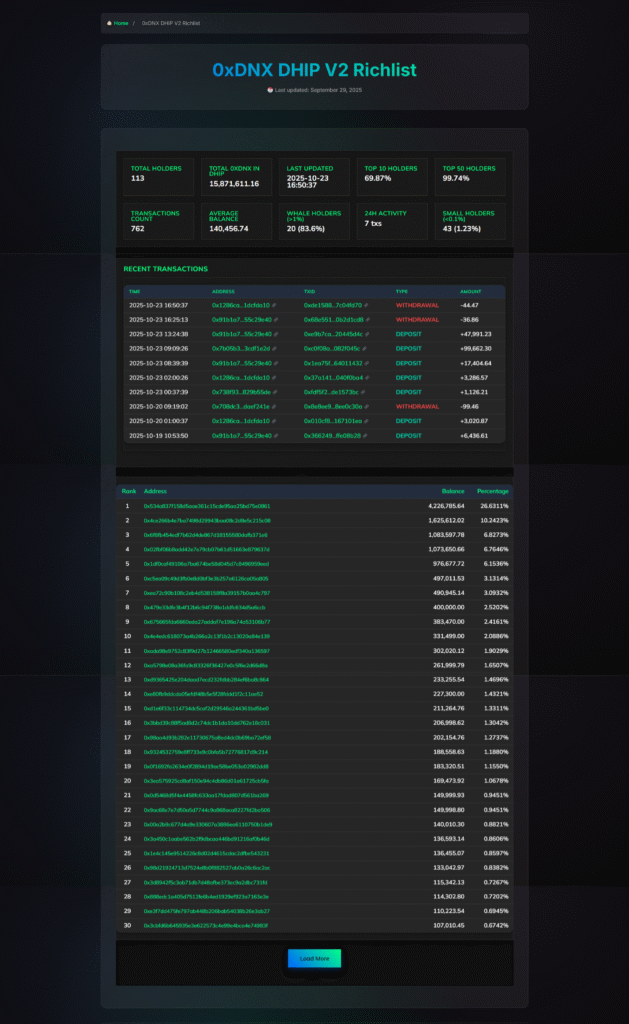
What does the Summary Statistics panel show and how do I read it?
The top panel shows four metrics that give you the full distribution picture without reading individual rows — the most important is the top 10 concentration percentage, which tells you immediately whether supply is genuinely distributed or held by a small group.
- Total holders — the number of unique Ethereum addresses currently holding 0xDNX. This is the actual participant count in DHIP, not an estimate.
- Total 0xDNX in DHIP — the total supply of 0xDNX currently in the program, representing the combined DNX committed by all participants.
- Top 10 concentration percentage — what share of the total 0xDNX supply is held by the ten largest addresses. Above 70–80% means supply is heavily concentrated. Below 50% means distribution is meaningfully spread across the holder base.
- Top 50 concentration percentage — the same metric for the top 50 addresses. Comparing top 10 versus top 50 tells you whether there is a steep drop-off in holdings after the largest addresses or a more gradual distribution curve. A large gap between top 10 and top 50 percentages means a small number of whales dominate the program.
What data does each row in the richlist show?
Each row shows rank, full wallet address, token balance, and exact percentage of total supply — the percentage column is the one Etherscan does not calculate for you.
- Rank — position in the holder list ordered by balance descending, updated automatically as balances change.
- Wallet address — the full Ethereum address, linked directly to the Ethereum block explorer so you can verify the balance, see the transaction history, and check other token holdings independently.
- Token balance — the exact 0xDNX balance with configurable decimal precision.
- Percentage of total supply — the share of total 0xDNX held by that address. Etherscan shows raw balances but does not calculate this — you would have to manually divide each balance by total supply for every address. The richlist does it automatically for all holders simultaneously.
How do filtering and real-time updates work?
Set a minimum balance or minimum percentage threshold to trim the list to addresses large enough to have meaningful market impact — for example, filtering to addresses holding more than 1% of supply immediately shows you how many participants that threshold captures.
The list refreshes automatically at configurable intervals without a page reload. Changes to holder balances appear within minutes of the Ethereum blockchain updating. A new address entering DHIP appears in the ranked list as soon as the transaction confirms. An existing holder exiting drops their address from the list and updates the holder count and concentration statistics immediately.
What patterns in the richlist are worth watching for trading decisions?
Is the top 10 concentration percentage rising or falling over time?
A rising top 10 concentration percentage month over month means supply is consolidating into fewer hands — either smaller holders are exiting DHIP or larger addresses are accumulating more. A falling percentage means new participants are entering and distributing supply more broadly. Neither direction is inherently bullish or bearish, but the trend matters for assessing whether the program is growing or contracting at the participant level.
What does a new large address appearing in the top 20 signal?
A new address appearing in the top 20 that was not previously in the richlist means a significant amount of DNX has been newly committed to DHIP — a direct signal of fresh conviction from a large participant. Conversely, a top-20 address disappearing from the list means a large holder has exited, which is worth noting as a potential supply event depending on what they do with the unlocked DNX.
What does the total holder count trend tell you?
Total holder count growing steadily indicates DHIP is attracting new participants. Stagnant or declining holder count while total 0xDNX supply stays constant means existing holders are consolidating positions rather than new participants entering — concentration rises without any single large exit event. Both patterns read differently from the raw DNX price chart alone and provide on-chain context for price moves.
Frequently Asked Questions
What is 0xDNX?
0xDNX is an ERC-20 token on Ethereum representing DNX locked in the Dynex Holder Incentive Program (DHIP). It is not the same as native DNX on the Dynex chain. When you participate in DHIP, your DNX is wrapped and you receive 0xDNX tokens representing your locked position in the program.
Why is the richlist on Ethereum rather than the Dynex chain?
Because 0xDNX is an ERC-20 token that lives on Ethereum. The richlist connects directly to the Ethereum blockchain to scan all addresses holding 0xDNX and calculate balances and supply percentages. All wallet address links point to the Ethereum block explorer, not the Dynex block explorer.
How is this different from checking Etherscan directly?
Etherscan shows raw 0xDNX balances but does not calculate percentage of total supply per address, does not show top 10 and top 50 concentration statistics, and does not maintain a ranked, auto-updating list. You would have to manually divide each balance by total supply and sort the results yourself. This richlist does all of that automatically and keeps it current without you touching anything.
How often does it update?
The richlist refreshes automatically at configurable intervals. Balance changes appear within minutes of the Ethereum blockchain updating — no page reload needed.
Is it free?
Yes, currently free with no registration required.
→ Open the 0xDNX DHIP v2 Richlist — updates automatically, no login required.
Technical overview on GitHub: dynex-0xdnx-dhip-richlist-monitor. See all Logic Encoder tools at the applications page.
Leave a Reply